Sunday, 20 March 2011

Testing Fonts

My initial thoughts when trying to decide which Font to use for our opening credits were size and colour but actually there is much more theory behind the final product. Possibles are previewed below stating my opinion beside them.


Monday, 7 February 2011

Opening Sequence Analysis - 'Panic Room'


'It was supposed to be the safest room in the house.'

Panic Room (2002)
Genres: Thriller, Drama
Certificate: 15
Directors: David Fincher
Writers: David Koepp
Cast: Jodie Foster, Kristen Stewart, Forest Whitaker
Production company: Columbia pictures corporation

A woman and her teenage daughter become imprisoned in the panic room of their own house by 3 criminals. SOURCE - IMDb

I chose to analyse the opening of Panic Room because it is similar in how it seeks to scare its audience (as I learnt watching the whole film), and its genre is similar to that of the film I would want to produce. Before the film begins the production company is shown, in this case Columbia. As the screen then fades to black sounds generally found in a busy street are heard along with an eerie piece of music. We then see an establishing shot of a city in the U.S.A which is evident by the shape of the buildings where Columbia is again shown. It then flicks to the next shot which is of a building closer to the distance in the previous shot as an actor’s name is present. This is continued in a cohesive manner, occasionally moving from one shot to the next in a more exciting transition. The buildings shadows are included, likely to be to make the city appear darker to set the scene. The camera movement I found interesting because the camera is always slightly edging forward it is never completely stationary. The range of different angles used are also interesting.  Behind the credits showing on buildings there is traffic and pedestrians present in the background just to clarify that the film is not set in a ghost town. The music that had remained throughout all of the previous clips mentioned then changes suddenly when the title of the film is shown to highlight the name and from this point forward the music is of a different nature, louder, more dominant and fast paced with a slight ticking sound joining it. The amount of time between each new shot speeds up also. After a short time the music then returns to the soundtrack from the beginning of the sequence only with added sounds. The credits them self appear 3D and don’t stand out against the buildings because they are grey. Just over 2 minutes in, the background changes to a park in daylight with a reasonable amount of people spread out, this is when the dialogue begins but it is off-screen. The main character is then established, walking towards the camera in a street, the music is still faintly present.

Friday, 28 January 2011

Copy of - The script

This is the script I prepared a few days prior to filming, for both the actors (to learn dialogue in advance) and the Camera crew/ Director (for other purposes such as knowing where to be, where to shoot from and where to expect the actors to appear from) to use when rehearsing and filming our Opening Sequence.


Thursday, 6 January 2011

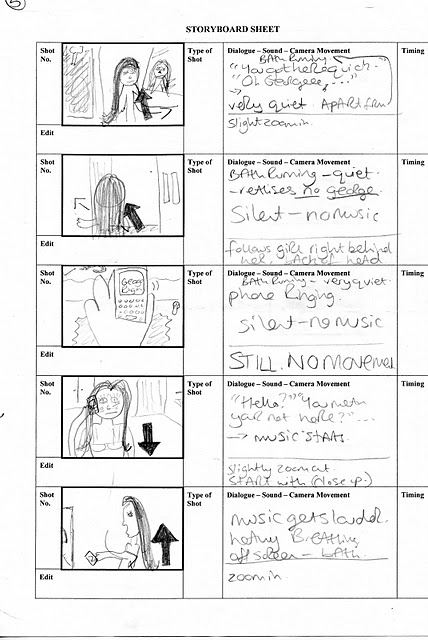
Where it all begun - Story Boards


Above is a copy of the story board I created over the christmas holidays. I didn't include the type of shot because I think its obvious what time of shot it is from my sketches :) nor did I specify the time of each shot because this was really just a rough copy and I wasn't sure how long each would be. Plus I knew there would be lot's of changed made to it.

Monday, 3 January 2011

Researching into - Genre + Audience

Below is a tally chart I created to explore into different age groups, finding out what their favourite genre for film is. I asked 40 people from each age group and these are the results I got:


As you can see from the chart, Horror was popular with all age groups but teens and under 25's in particular. Therefore I decided the Opening Sequence story board I was to design would be of this genre, targeting 16-25 year old's as my audience, I thought this wouldn't be to difficult seeing as I am in that category so I would just ask friends of a similar age what they thought as well as creating something I myself would enjoy.

Sunday, 2 January 2011

Preliminary Sequence


TASK:
To film and edit a character opening a door, crossing a room and sitting down opposite another character. They converse. Should demonstrate match on action, shot/reverse shot and the 180 degree rule. Last a maximum of 2 minutes.


The above clip is of my groups Preliminary Sequence demonstrating some examples of successful camera work and exploration of angles, in the preparation of filming our Opening Sequence.
I would have liked to have more time to plan this exercise and include credits. Shooting and editing took 2 hours in total.


Wednesday, 29 December 2010

Editing essay - Pillow Talk VS Fringe


FRINGE VS. PILLOW TALK
“How are the sequences from ‘Pillow Talk’ and ‘Fringe’ different? Discuss the differences in pace and style of editing as well as the effect the editing has on meaning/ the audiences reception of the extracts”.

Fringe and Pillow Talk are very different in terms of pace. Fringe, for example has a lot of cuts in the beginning of the extract that are quick. When the characters are conversing is when this is at its fastest, as little as a cut every few seconds. Whereas in Pillow Talk, there are no cuts in the first conversation, one cut in the second, and hardly any in the third. The difference in cutting is because Fringe is a more modernized film, but Pillow Talk is an old fashioned film and therefore is quite outdated when it comes to technology.
Styles of editing in the two clips again, don’t have much in common. Fringe demonstrates lots of fancy ways to move from one cut into the next, such as close ups at the start, showing reactions and facial expressions more clearly, as well as zooming, long shots and straight cuts. The camera is also always moving even if it is barely even noticeable. Pillow Talk, on the other hand has fewer examples of editing, consisting of only mid shots with no transition and long shots with a straight cut and then split screens. A small number of close ups is used, but they are present and the camera stays still throughout the whole extract. This portrays a general lack of education in editing.
Editing can have an effect on the audience reception of an extract. For example, Pillow Talks slow pace is likely to not appease a younger viewer. Or it may not appeal to those who like action due to not much happening on screen and type of genre and this could also cause the audience to perceive the film differently than the editors and directors intended it to be.
To conclude, although fringe and Pillow Talk have differences, they do share some similarities like they both use straight cuts (and vary on pace), and they both jump to the near future in each shot.


ELLA TRAINOR